- From Day One: People & HR
- Posts
- Putting the Human Back in HR
Putting the Human Back in HR

From Day One Editors
February 26, 2026 • Estimated Reading Time: 9 minutes
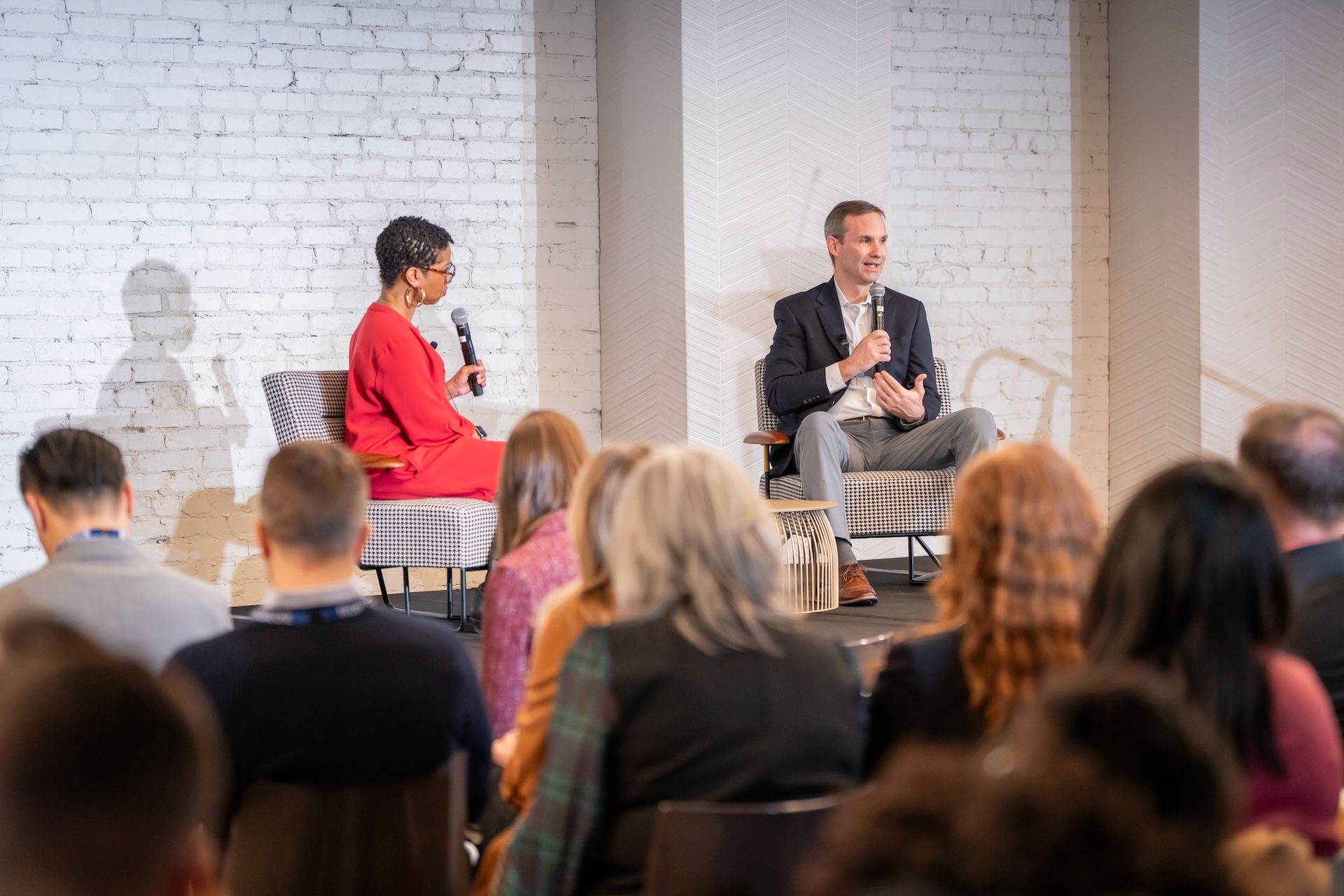
Six weeks after starting a new job, Katy Theroux got a breast cancer diagnosis. A fireside chat at From Day One’s Houston conference gave her the opportunity to say it plainly, and to draw a direct line between her experience and her philosophy of HR leadership.
“It wasn’t on my bingo card,” said Theroux, CHRO at Westlake, a Fortune 500 specialty-chemical and building-products company headquartered in Houston. “Nobody puts breast cancer on their bingo card.” She finished treatment just two and a half weeks before the event. The company, she says, had been unwavering in its support; a reflection of the family-owned culture that shapes Westlake even at its considerable scale.
The conversation, moderated by Sean McCrory, editor in chief at the Houston Business Journal, covered AI’s role in HR, leadership transitions, and what it really means to build a culture of care.
Resilience as a Core HR Skill
Theroux first arrived in Houston in 2002, just as the Enron and Arthur Andersen scandals were reshaping the city’s business identity. When she returned more than a decade later, the city had changed–the Texas Medical Center had nearly doubled in size–but the underlying dynamic of turbulence had not. “There’s always so much change in Houston,” she said. “Each company has had its share of ups and downs. Having an HR leader who can handle the highs and help navigate the lows is really, really important.”

Resilience isn’t a personality trait, but a practiced skill, and an especially vital one when companies face leadership transitions, she says. Over 18 years at two organizations before joining Westlake, Theroux navigated five CEO changes. She observed that what makes or breaks those transitions isn’t strategy—it’s honesty. “The most important element of a successful onboarding of a new leader is just real honesty about themselves, their background, and what they’re trying to find out,” she said. “Through that honesty, it really builds trust. And trust is key to long-term success.”
AI as an Amplifier, Not a Replacement
At Westlake, the HR team is experimenting with tools including Microsoft Copilot and an internal GPT system, says Theroux. She frames AI as the latest chapter in a longer story about freeing HR professionals to do more meaningful work.
“What we’ve been trying to do for the past 20 to 25 years is take administrative work off our frontline HR leaders so they can spend more time with people,” she said. “I view AI as the next step in that evolution.” One of the most common current uses is drafting job descriptions, by pulling from internal databases, org charts, and historical records to quickly produce relevant drafts. But she was candid about the limits: AI-generated job descriptions are accurate roughly 70% to 80% of the time, which means careful human review remains essential. “Everyone needs an editor,” McCrory said, “including AI.”
Theroux’s broader advice for implementing AI responsibly was to start small. For example, she observed that pilot programs reduce risk, build trust with business partners, and create the kind of joint ownership that allows successful tools to scale naturally. She also emphasized the need to partner closely with technology leadership to ensure any AI use aligns with company policy. “There has to be a real business need,” she stated. “It’s not about replacing people. It’s about doing work better.”
RECENT EVENT HIGHLIGHTS
While much fuss has been made about AI’s negatives, its biggest benefits directly help HR teams, especially in TA. “The AI sweet spot is gathering, synthesizing, and summarizing information, stopping short of decision-making, but helping to get to know the inputs on candidates a bit better,” said Craig Ellis of HighMatch. | How do you practice self-care? For panelists in Houston, the answers were diverse: Reading. Running marathons. Meditation. Socializing. Stopping mindless scrolling. Weightlifting. Listening to audiobooks. Baking. This eclectic list demonstrates that the true definition of “wellness” is something highly varied and acutely personal. |


“Automation has disrupted work for decades,” said Elise Furlan, president, chief people & legal officer, for SICK Sensor Intelligence. But with the rapid advent of AI tools in the modern workplace, she says companies need to be aware of them to avoid obsolescence. How can HR leaders engage with this tech and use it to shift focus to higher-value tasks? | One test of Matt Jackson’s leadership was supporting a team member’s return from maternity leave. “I don’t know what I should say. I don’t know what I shouldn’t say,” he said. Jackson, chief growth officer at Unmind, used the company’s AI coach, trained in policies and empathetic communication, which gave him guidance in just three minutes. |


Upcoming Webinars
February 26
Comprehensive, family-focused health benefits are no longer just a perk. They’re a strategic tool for managing costs, improving outcomes, and strengthening engagement. Backed by new insights from our audience research, this session will explore how a smarter benefits design can deliver value for both employees and the business. Which benefits have the greatest opportunity to reduce healthcare costs? What makes a family health benefit comprehensive and inclusive for today’s workforce? How can companies measure the ROI on their offerings?
March 10
Employee financial stress looks different across generations, roles, and industries, but the impact on engagement and retention is universal. In this session, leaders from different industries will share how they transformed financial well-being from a passive benefit into a high impact engagement driver. You’ll hear how these employers increased engagement tenfold by offering financial benefits that meet employees where they are, combining personalized tools, product perks, and relevant education across every stage of the employee lifecycle. Speakers will discuss which incentives actually move employees to act, why clear and repeated communication matters, and how embracing intentional over marketing helped cut through noise and drive sustained utilization.
March 12
Benefits budgets are under continued scrutiny. Health premiums are at a 15-year high, and the gap between what employees need and what employers can afford keeps getting wider. For years, Lifestyle Spending Accounts were treated as far-ranging, discretionary lifestyle perks. But new data from Forma’s 2026 LSA Benchmark Report tells a different story. Built on insights from 300+ employers and 1 million employees across 110 countries, the report shows a clear shift: leading organizations use LSAs as infrastructure to deliver purposeful benefits efficiently, not as an overwhelmingly broad perk.
March 24
Too many executive hiring conversations begin with resumes and role requirements, when they should begin with a clear definition of the business problem a leader is being hired to solve. In this webinar, leaders from Morgan Samuels will explore why traditional executive search methods often miss the mark and how a problem-first, outcome-driven approach leads to faster hiring, stronger alignment, and better performance. Why do executive hiring conversations so often start with skills, background, and titles instead of the business problem to be solved? What are the hidden costs of poorly defined leadership problems? How does clarity around outcomes and success measures change the way candidates are evaluated?
March 31
Cell and gene therapies are moving rapidly from the research pipeline into real-world care. As these therapies become more prevalent, HR and benefits leaders are navigating a new set of questions: how to support employee access to breakthrough treatments, how to manage financial exposure and oversight, and how to prepare benefit strategies for a category of care still taking shape. In this webinar, industry leaders will offer clarity on how employers can begin to think strategically about readiness, governance, and long-term sustainability—highlighting what matters most today and which capabilities will grow in importance as cell and gene therapies emerge as a distinct high-cost category.
April & Beyond:
Sponsor Spotlight: Reward Gateway
How the Georgia Aquarium Cares for Its People:
When a beluga trainer at Georgia Aquarium took on the challenge of managing recognition programs, she gained project management skills far beyond her role of caring for marine mammals. That sort of cross-functional development opportunity is the perfect example of how the popular Atlanta attraction is breaking down silos among its 700-person workforce; a team that ranges from life support operators who maintain precise water conditions to hospitality staff welcoming millions of guests every year. Read the full story here.
Sponsor Spotlight: Augeo Workplace Engagement
Powering the Future of Work: A New Perspective on Designing Connection That Scales.
“How do we scale connection? How do you support growth, recognizing and realizing that growth is redefined and defined by every individual on a one-on-one basis?” asked Matt Garrett, COO and CMO of Augeo Workplace Engagement. The answer starts with understanding what engagement actually looks like in daily work. It’s not the large, scheduled events that define culture, but the small, repeated interactions that signal whether someone is seen, supported, and developing. Read the full story here.
From Day One in a City Near You

Convene on 101 Park Ave
Convene on 101 Park Ave
JFK Presidential Library & Museum
Computer History Museum in Mountain View
Computer History Museum in Mountain View
Seattle Art Museum in Downtown Seattle
McNamara Alumni Center at the University of Minnesota
The Art Institute of Chicago in Grant Park
Alfred Lerner Hall at Columbia University
AT&T Executive Education and Conference Center
The Union League of Philadelphia
Venue Six10 in Downtown Chicago
Half-Day Virtual Conferences
A single job posting can attract hundreds, or even thousands, of applications due to accessible hiring platforms and technology. For talent teams, the challenge is no longer just attracting interest, but quickly identifying the right candidates, maintaining a fair process, and aligning hiring with long-term business goals. How can employers use AI and automation to streamline hiring without compromising fairness or human judgment? How is skills-based hiring changing how companies define fit and evaluate candidates?
With so much content online, getting the right material in front of the right people is as challenging as creating it. Marketers are focusing on smarter content distribution strategies and SEO integration to ensure their work actually gets seen. What mix of channels–including owned media, social, search, email, and more–is most effective for amplifying content reach, and how should marketers decide where to invest their efforts? How are algorithm and technology changes impacting content visibility, and how can content marketers adapt their distribution tactics in response?
Frontline, hourly workers keep businesses running but often face unique challenges, from limited access to training to feeling disconnected from corporate support. Employers need fresh strategies to attract and retain this vital workforce while investing in their growth and engagement. What innovative approaches, tech, and tools, are helping companies attract and retain frontline talent in a competitive labor market? How can employers design upskilling and development programs that fit the realities of frontline roles? In what ways can technology and communication tools improve connection and inclusion for this population?
As employees seek more from their workplace, support for mental health, family care, financial stability, and long-term security, benefits leaders are under pressure to deliver comprehensive solutions, even while meeting corporate needs for cost controls. What are the most in-demand benefits today, and how are employers prioritizing them? How can companies build total rewards strategies that are both sustainable and responsive to evolving employee needs? How are companies using feedback to refine and communicate their benefits?
Brand marketers shape a company’s identity, reputation, and emotional connection through positioning, messaging, and storytelling. At the same time, consumers are quick to spot empty messaging and trend-following. To build trust and stand out, companies have to focus on consistent communication across channels like email, social media, influencer partnerships, and advertising. How can brands create authentic stories that truly resonate? How can they balance standing out with building trust and long-term loyalty?
Today’s employees are juggling caregiving, financial stress, and the daily challenge of staying mentally and physically well. How can employers tailor benefits to meet the distinct needs of multiple generations in the workforce while maximizing engagement and ROI? What are the most effective and forward-thinking benefits, from financial wellness and mental health resources to reproductive care and family support? How can companies evaluate the impact of their offerings on retention, engagement, and workplace culture?
With third-party cookies on the way out and stricter privacy regulations, marketers are rethinking how they measure and attribute success. Traditional tracking is getting harder, yet demonstrating ROI remains a top priority. How can marketers adapt attribution models when faced with data gaps? How can marketing teams leverage AI and machine learning to predict customer behavior or campaign outcomes? How can leaders elevate their team’s data literacy and ensure that employees at all levels can interpret and act on analytics insights?
Even with tighter budgets and leaner teams, employees are expected to continually deliver. Employers need smart tools and strategies that boost productivity while supporting performance and checking in on employees in ways that feel helpful rather than overbearing. What tools and technologies are proven to help employees work smarter, not harder? How can AI help workers save time on routine tasks so they can focus on what really matters? How can leaders measure productivity in ways that capture quality, creativity, and collaboration, not just hours worked?
Organizations must prepare for a future shaped by new technologies, changing employee expectations, and evolving social and economic trends. Success depends on adapting culture, strategy, and workforce models to thrive. What emerging technologies and workplace models will most impact how work gets done in the next five years? How can organizations build inclusive and resilient cultures that attract and retain diverse talent? How should companies balance automation and human skills to create meaningful and productive work?